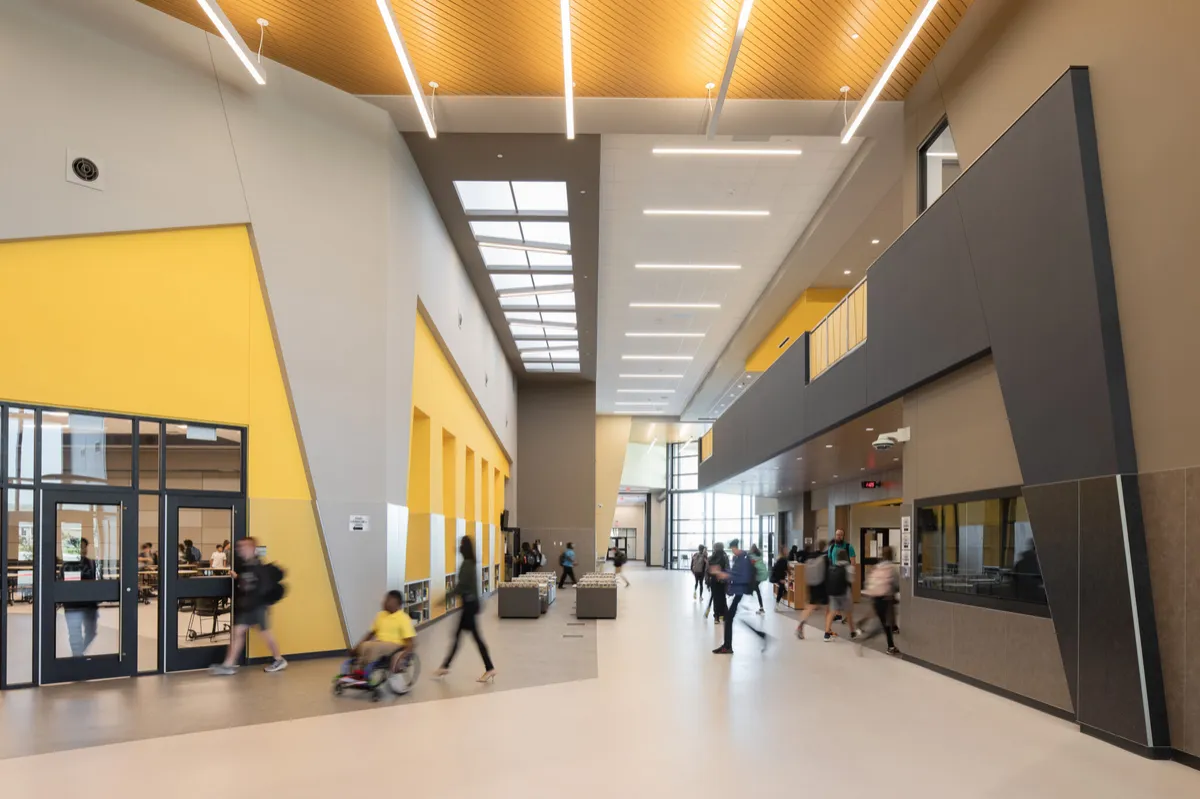
The Weekly System, Vol 13: Solatube Daylighting in Education
The Weekly System: Solatube in Education
Daylight Should Reach More Than the Window Seats
How tubular daylighting can improve visual comfort, preserve usable wall space, reduce daytime electric-lighting demand, and bring natural light deeper into educational buildings
Schools contain almost every kind of space a lighting designer could encounter.
There are classrooms where students move between written work and digital screens. Libraries where every available wall may be needed for shelving. Gymnasiums with high ceilings and enormous lighting demands. Corridors, commons, and interior rooms that may sit far beyond the reach of conventional windows.
A single daylighting strategy rarely works equally well across all of them.
Windows remain an important part of educational design, but they cannot always deliver balanced daylight throughout a deep floorplate. They can also introduce glare, uneven brightness, and solar heat gain when daylight is not properly controlled.
Solatube approaches the problem differently. Its tubular daylighting systems capture daylight at the roof, transfer it through highly reflective tubing, and distribute it through ceiling-level diffusers. That allows designers to bring natural light into spaces that conventional windows and skylights may struggle to reach.
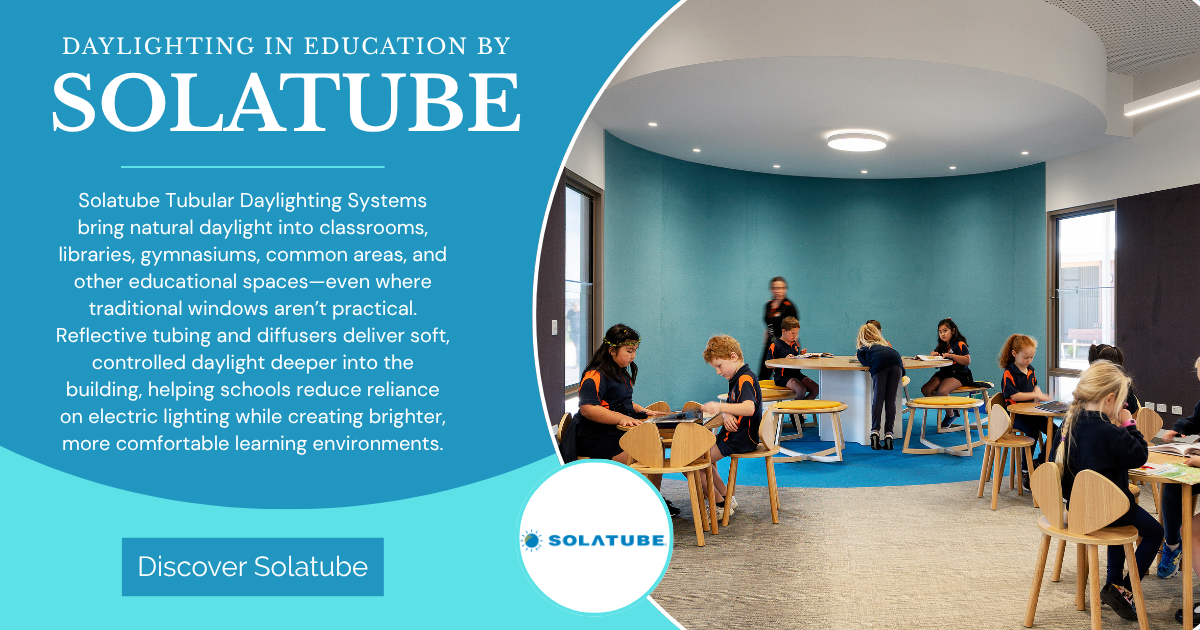
When the Light Becomes the Distraction
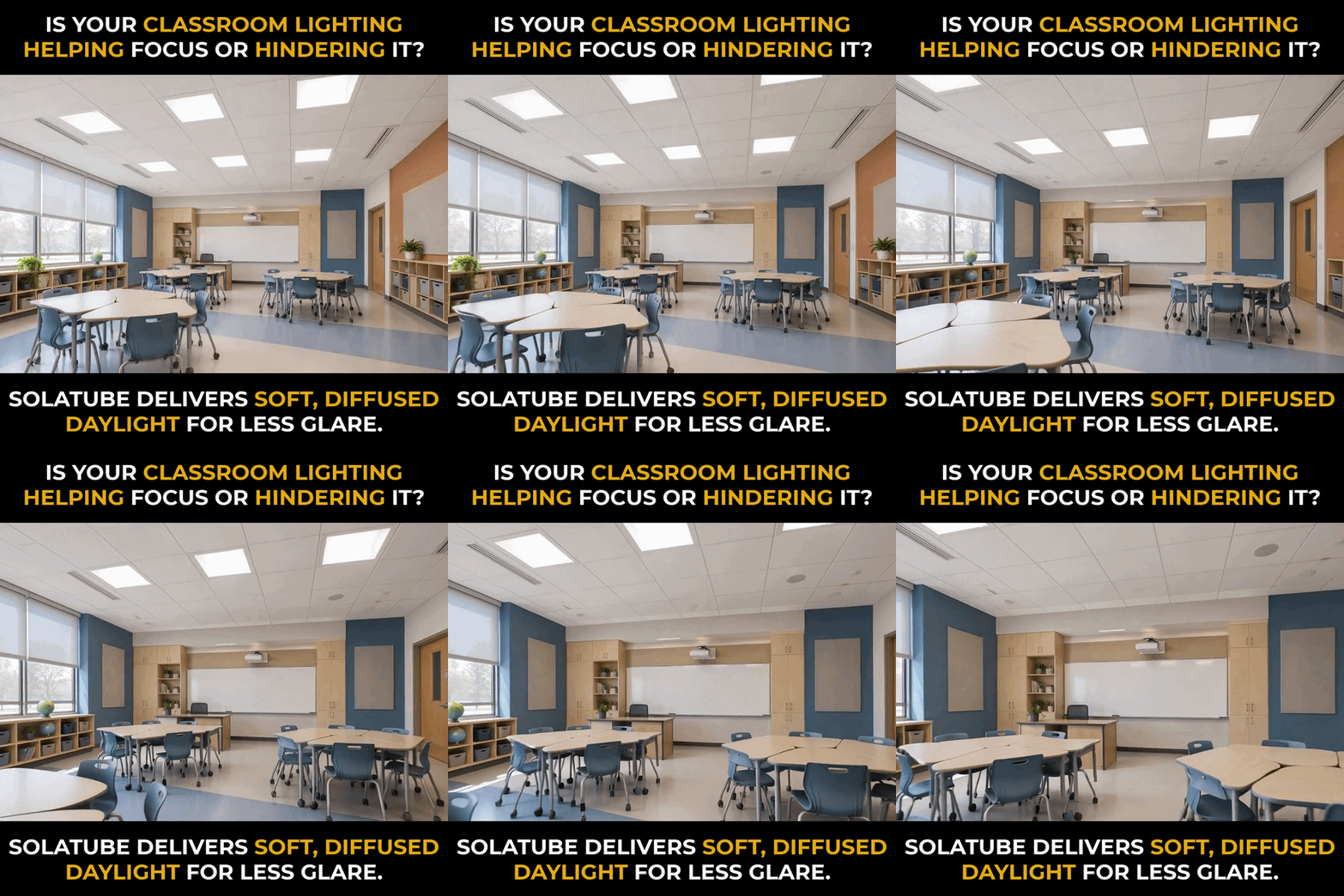
More daylight is not automatically better daylight.
A classroom can have generous windows and still experience sharp contrast, reflected glare on screens, bright patches across desks, and significant differences between the window side of the room and its interior. Direct sunlight may also introduce unwanted heat during parts of the school day.
The objective is not simply to admit as much sunlight as possible. It is to create useful illumination that supports the activities happening below it.
Solatube captures daylight at the roof and redirects it through reflective tubing before delivering it through a diffuser at the ceiling. Solatube’s OptiView DaylightShaping diffusers are designed to spread that light more evenly across the occupied space, helping avoid the concentrated beam associated with a conventional opening.
This overhead distribution can be particularly useful in classrooms, where students need to see work surfaces, whiteboards, teachers, and digital displays without constantly adjusting to extreme differences in brightness.
Solatube also offers components intended to limit unwanted heat gain and filter ultraviolet light. That distinction matters in education: the goal is to bring the visual and experiential benefits of daylight into the classroom without importing every problem associated with uncontrolled direct sun.
The Library Still Needs Its Walls
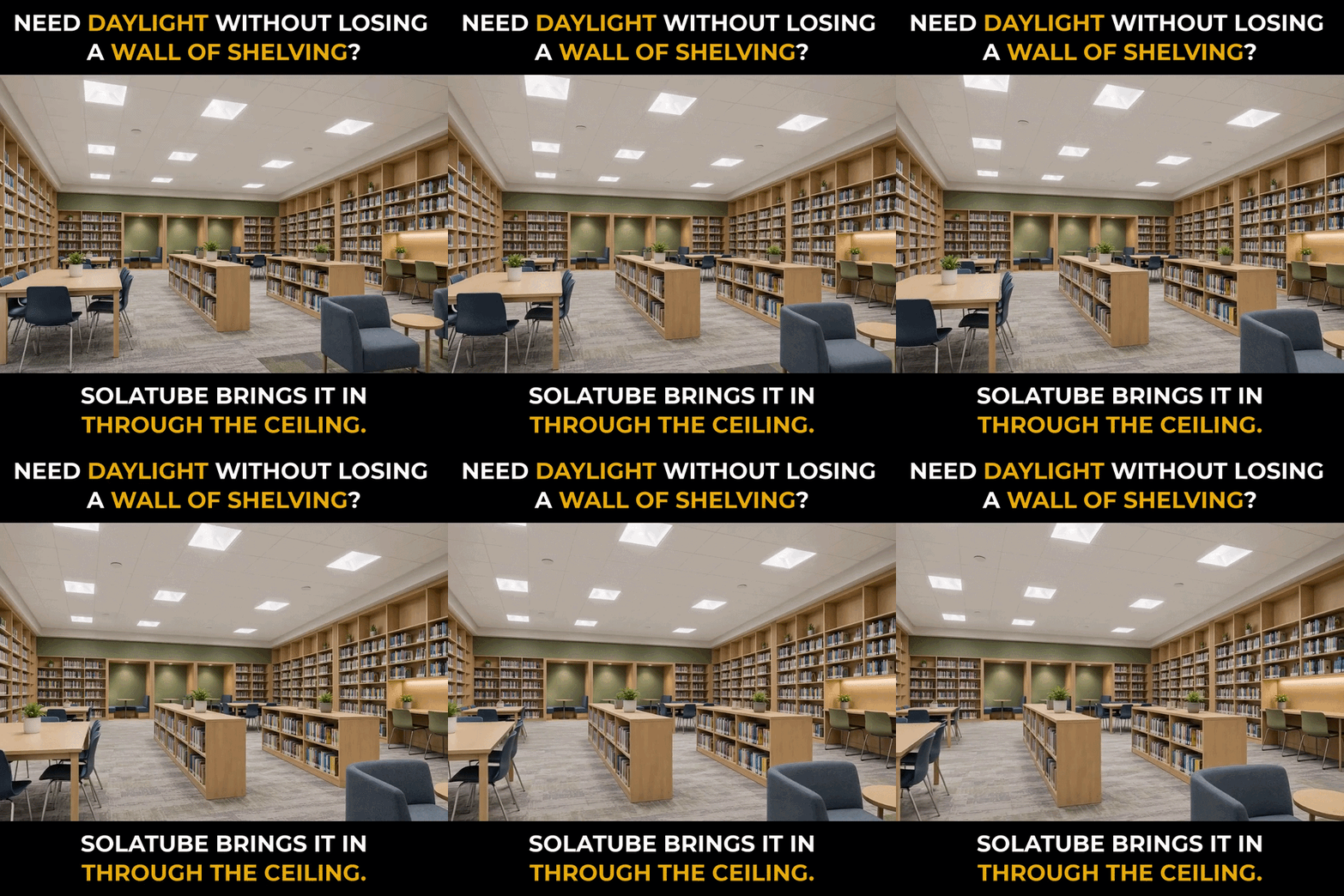
Libraries are asked to perform several jobs at once.
They hold collections, provide quiet study areas, accommodate technology, host small-group work, and increasingly operate as flexible learning commons. Every perimeter wall may already have a purpose before daylighting enters the conversation.
Adding or enlarging windows can reduce the wall area available for shelving, display systems, writing surfaces, and integrated storage. Depending on the building orientation, it may also create glare across computer screens and reading tables.
Tubular daylighting introduces another route.
A Solatube system collects daylight at roof level and delivers it through the ceiling, allowing light to reach reading and study areas without requiring another opening in the wall. In a closed-ceiling application, square or round diffusers can be coordinated with the ceiling grid and planned around furniture layouts, circulation routes, shelving, and task areas.
The SolaMaster Series is designed for commercial applications with open or closed ceilings. Its reflective extension tubing can accommodate different lengths and angles—including configurations with bends of up to 90 degrees—so the daylight path can be coordinated around structural members and mechanical services.
For designers, that creates an opportunity to treat daylight as part of the reflected ceiling plan rather than as a condition limited to the building perimeter.
The shelving stays. The daylight simply takes a different route.
The Gym Is Already Under the Sun
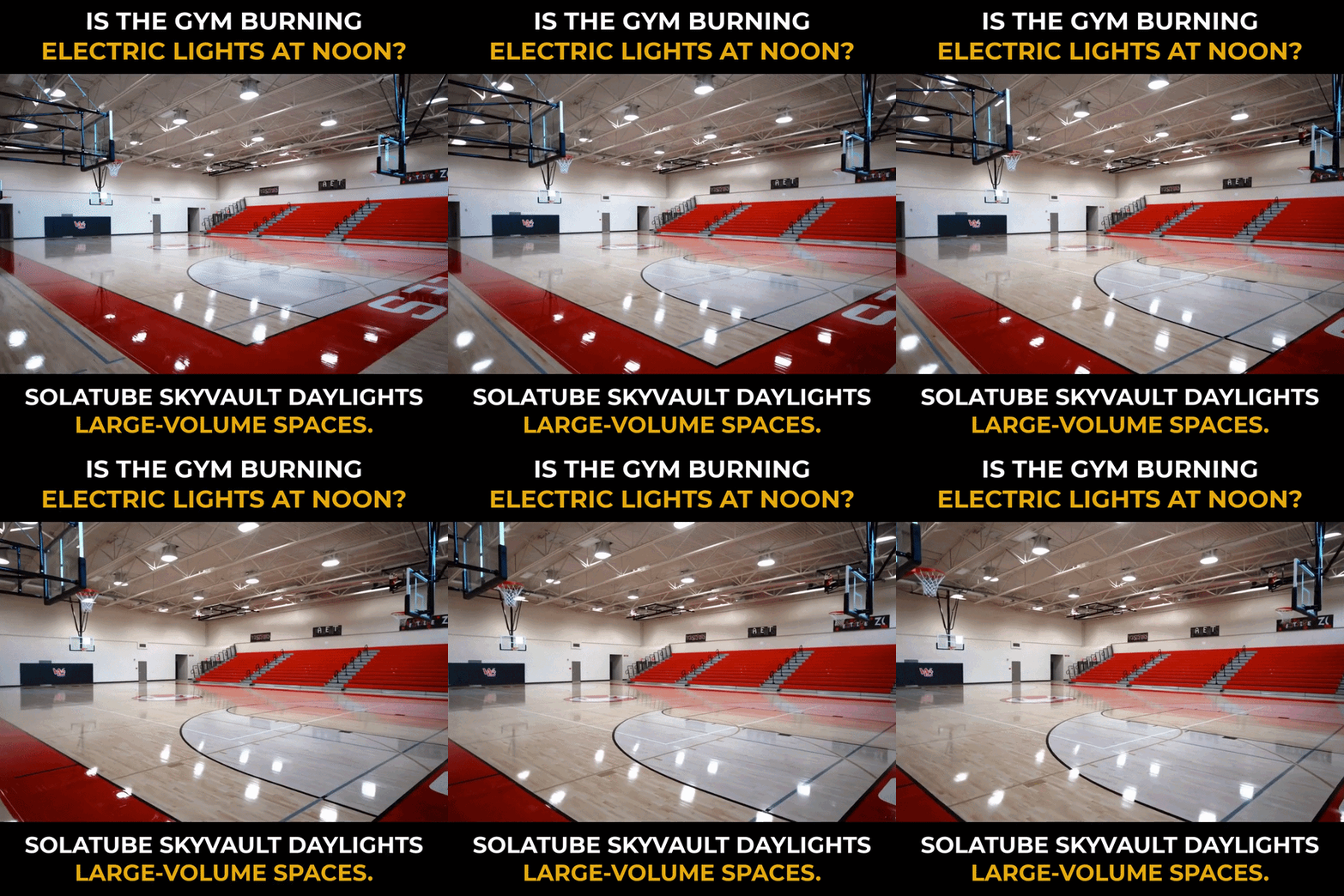
Gymnasiums present a different scale of lighting problem.
The ceilings are higher. The floor area is larger. Fixtures must deliver sufficient illumination across courts, bleachers, circulation areas, and activity zones. Even during the middle of a bright day, many gyms remain dependent on electric lighting because conventional windows cannot illuminate the full volume evenly.
Solatube’s SkyVault Series is designed for large, high-ceiling applications such as gymnasiums, common areas, warehouses, and stadium spaces.
At the centre of the series is the M74 DS, which uses a 29-inch tube and can accommodate runs of up to 100 feet. Its collector is designed to redirect lower-angle daylight into the system while filtering infrared heat. At the bottom of the assembly, diffuser options and the optional SkyVault Amplifier help project and distribute daylight toward the occupied area below.
A properly planned daylighting layout can reduce how heavily a gym relies on electric fixtures during bright daytime conditions. The actual number, spacing, and configuration of systems will depend on the gym’s dimensions, ceiling height, roof construction, climate, orientation, and target illumination levels.
The point is not that electric lighting becomes unnecessary. Schools still need reliable light during early mornings, evenings, dark weather, and scheduled events.
The opportunity is to stop treating full electric output as the only daytime option when a substantial source of natural light is already available above the roof.
Interior Does Not Have to Mean Dim
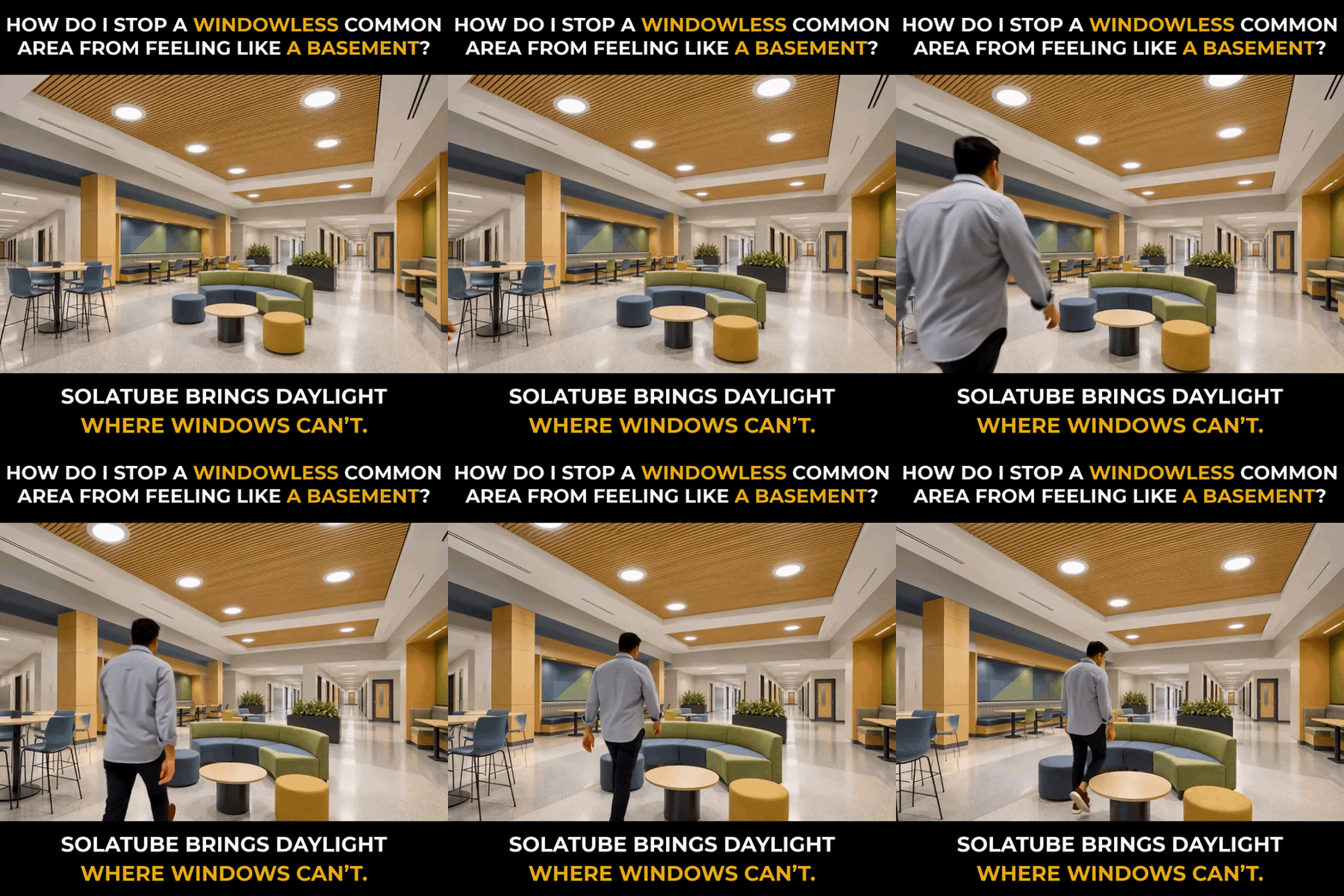
Not every educational space can sit along the perimeter.
Deep floorplates often leave corridors, commons, collaboration zones, restrooms, support spaces, and even classrooms without a direct exterior window. Those areas may be entirely functional, yet the absence of daylight can make them feel disconnected from the rest of the building.
Traditional skylights are not always able to solve the problem. The room may not sit directly below an appropriate roof opening, or structural beams, mechanical equipment, and other building services may interrupt a straight vertical path.
Solatube systems are modular. Their reflective extension tubing can be lengthened and redirected to navigate around obstacles and carry daylight toward harder-to-reach areas.
That flexibility is especially relevant in renovation projects, where the designer must work with an existing structural grid and established mechanical systems. Instead of requiring a large open shaft between the roof and the room, the tubular system uses a comparatively compact pathway.
Multiple systems can then be distributed across an interior classroom or common area so that the room is illuminated by several diffusers rather than one concentrated source.
The result is not an imitation window or an artificial view. It is real daylight delivered from above to a part of the school that might otherwise receive none.
Daylight When the Lesson Wants It
Daylight is valuable, but educational spaces still need control.
A classroom may be brightly illuminated for reading and group work, then need lower light levels for a projector, video presentation, assessment, or another activity. That change should not require covering every diffuser or abandoning daylighting altogether.
Solatube offers an optional 0–10V Daylight Dimmer for compatible systems. The dimmer uses an internal butterfly-style baffle to regulate the amount of daylight passing through the tube and can work with a wall-mounted controller or a broader compatible lighting-control strategy.
This gives educators and facilities teams the ability to dial daylight back when the room needs different conditions, then reopen the system when the activity changes.
It also reinforces an important specification principle: daylight and electric lighting should not be designed as unrelated systems. They can be planned together, with controls responding to occupancy, available daylight, teaching needs, and the requirements of each room.
Planning the System Around the School
The appropriate Solatube configuration will vary across a campus.
A standard classroom or library may call for multiple SolaMaster units coordinated with a suspended ceiling. A gymnasium or other large-volume space may require the higher-output SkyVault platform. Interior corridors and smaller support spaces may use another tube size or distribution strategy.
Solatube provides daylighting calculations and design support to help determine product selection, quantity, spacing, layout, and anticipated performance. Those decisions should account for local daylight conditions, building orientation, roof type, ceiling height, tube length, interior finishes, and the required light levels at the workplane.
This is what turns a roof product into a coordinated daylighting system.
What Matters Most
Educational daylighting is not simply about adding more glass.
It is about getting useful natural light to the places where students, teachers, and staff actually spend their time—and delivering it in a form that supports the room rather than disrupting it.
Solatube gives designers several ways to approach that challenge. SolaMaster can bring diffused daylight into classrooms and libraries while preserving valuable wall space. SkyVault can address the scale and ceiling heights of gymnasiums and other large-volume areas. Reflective extension tubing can route daylight beyond the perimeter, while optional controls allow it to respond when teaching activities change.
The larger lesson is straightforward: a room does not need to touch an exterior wall to participate in the daylighting strategy.
If you’re evaluating Solatube for classrooms, libraries, corridors, common areas, gymnasiums, or other educational spaces, The Ginger Grant Group can help you compare system types, diffuser options, tube routes, daylight controls, and application requirements for your project.