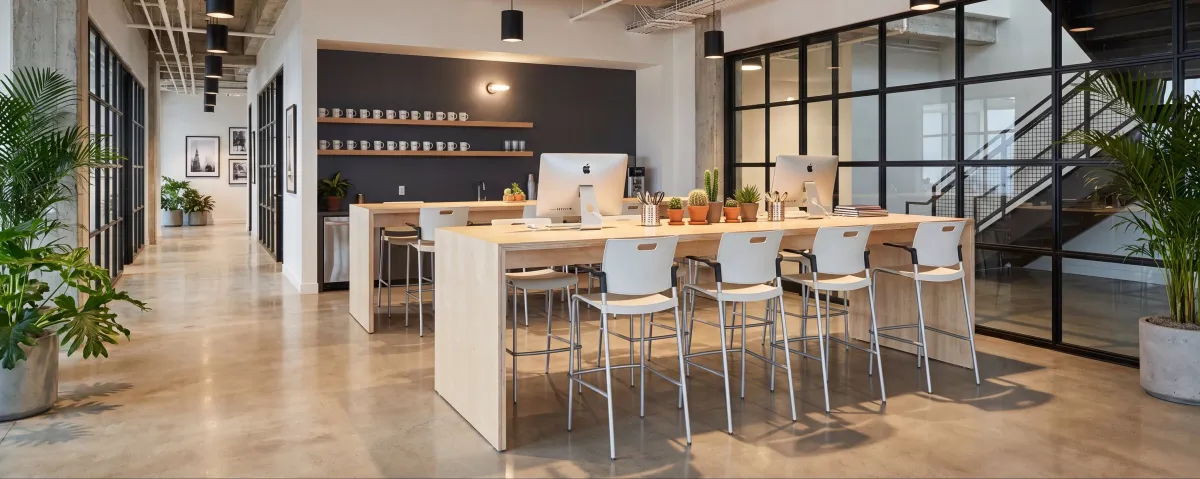
The Weekly Spec, Vol 30: Nightingale Butterfly Chair
The Weekly Spec: Nightingale Butterfly Stacking - Barstool - Task Chair
One Chair Family. More Ways to Use a Space.
The way we use commercial spaces is changing.
A meeting room might become a training area. A café doubles as an informal collaboration space. A workstation that once supported one task now serves several different activities throughout the day.
As spaces become more flexible, the furniture within them needs to keep up.
But flexibility can create another challenge for designers.
How do you provide the right seating for different activities without filling a workplace with unrelated chair styles?
That is where Nightingale's Butterfly seating collection offers an interesting solution.
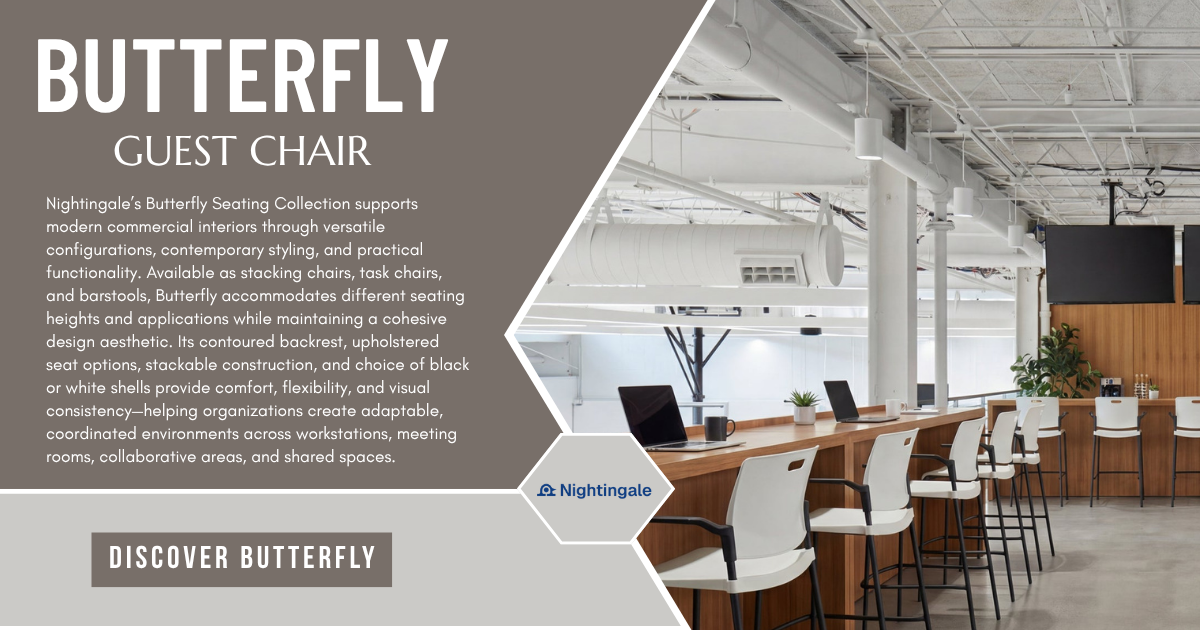
Butterfly is a lightweight, contemporary chair family designed to support a variety of commercial applications. The collection includes stackable guest chairs, barstools, and a less commonly recognized task chair configuration.
Across these models, the familiar Butterfly silhouette helps maintain visual consistency while allowing designers to select the seating type that best suits each environment.
The collection also offers black and white shell options, upholstery selections, and frame finishes that can be coordinated with the larger interior design.
One chair family. Different seating requirements. A more cohesive workplace.
Let's explore what makes Butterfly worth considering for the next commercial project.
The Room Changes. Why Shouldn't the Chairs?
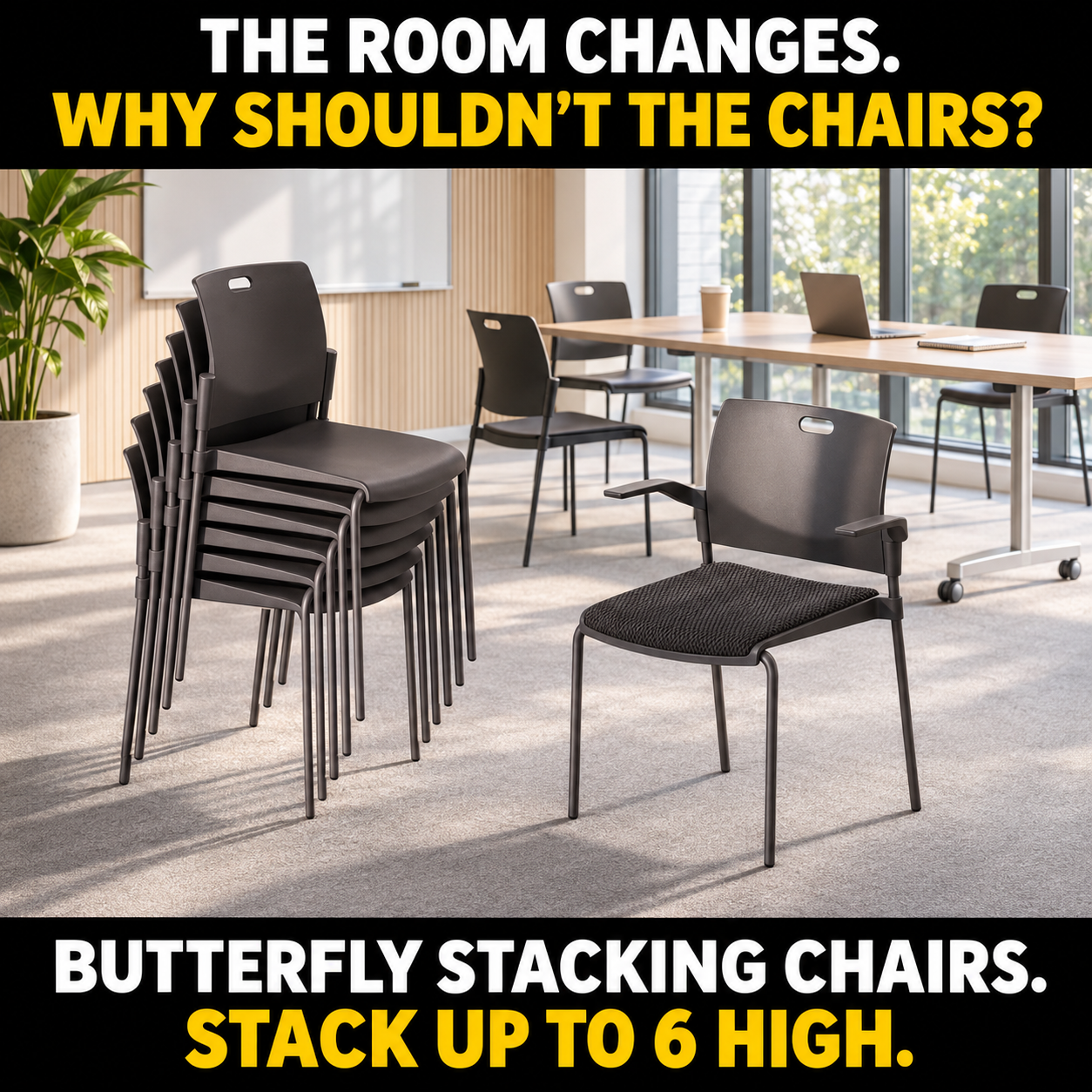
Butterfly stacking chairs bring flexibility to multi-use spaces.
Consider a typical meeting room.
On Monday, it hosts a training session for twenty people.
On Tuesday, the tables are rearranged for a collaborative workshop.
By Wednesday, half the chairs need to be removed to create more open floor space.
The room hasn't changed, but the way people use it certainly has.
This is a familiar challenge in modern workplaces, educational facilities, community spaces, and conference environments.
Furniture needs to be comfortable and appropriate for everyday use while remaining easy to move when the layout changes.
Nightingale addresses this need with the Butterfly stacking chair.
The Butterfly 808 and 811 models stack up to six chairs high, making them particularly useful in environments where seating is frequently rearranged.
Rather than requiring a separate storage area for every unused chair, stacking allows seating to be consolidated when it isn't needed.
Practical flexibility without sacrificing appearance
Stackability is often discussed as a storage benefit.
But its greater value may be the flexibility it creates for the space itself.
When chairs are easy to move and store, a room can transition between different activities with less effort.
The furniture supports the space instead of restricting it.
Butterfly's lightweight construction also makes it easier to reposition seating for impromptu meetings or changing group sizes.
The collection's clean lines help it complement contemporary interiors without introducing the utilitarian appearance sometimes associated with institutional stacking chairs.
Designers can choose between armless and arm-equipped versions, along with select upholstered-seat configurations.
Where Butterfly stacking chairs make sense
Potential applications include:
Training and meeting rooms
Multipurpose conference spaces
Educational and lecture environments
Reception and visitor seating
Collaborative work areas
Flexible community and amenity spaces
For project teams, the important question is not simply how many chairs fit around a table.
It is how the room needs to function when those chairs are moved.
A flexible room needs seating that allows the layout to change.
That is the purpose behind Butterfly's stacking models.
The Table Gets Taller. Why Change the Design?
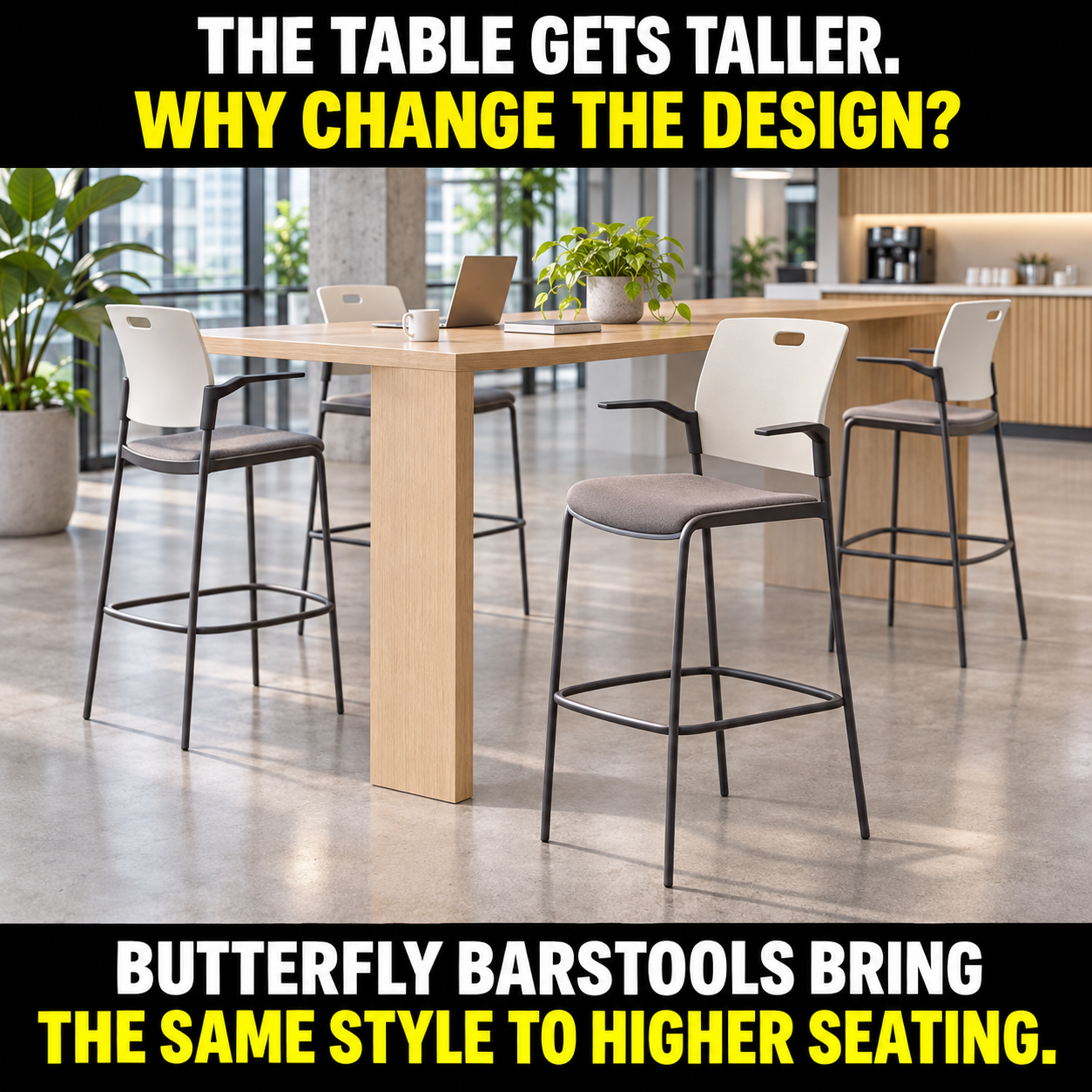
Butterfly barstools extend the same seating aesthetic to elevated work surfaces.
The modern workplace includes more than standard-height desks and conference tables.
Elevated counters have become common in office cafés, collaboration zones, hospitality environments, and informal meeting areas.
These spaces encourage people to gather, work briefly, or connect away from their primary workstation.
But introducing a higher table creates a new seating requirement.
A conventional chair is no longer the appropriate height.
The usual solution is to introduce a separate barstool design—often from an entirely different furniture collection.
That approach works functionally, but it can create a visual disconnect between adjoining spaces.
Nightingale Butterfly offers another option.
The Butterfly 809 and 810 barstools carry the same recognizable seat and back design into a taller seating configuration.
Their elevated frames incorporate foot support suited to bar-height applications.
According to Nightingale's product specifications, these models have a nominal seat height of 30 inches, making them appropriate for coordinating with compatible bar-height surfaces.
Consistency across the workplace
Imagine an office with a formal conference room, an informal café, and a collaborative counter nearby.
Each area serves a different purpose.
The conference room requires conventional seating.
The café uses taller stools.
The informal counter may be used for quick meetings or temporary laptop work.
Selecting Butterfly seating for these areas allows the designer to maintain a consistent appearance without using identical chair configurations everywhere.
The barstools are available in armless and arm-equipped versions, with upholstered-seat options.
That gives designers the ability to coordinate seating details while responding to the practical needs of each environment.
Why seat height matters
When specifying elevated seating, aesthetics should never be the only consideration.
The relationship between seat height, work surface height, and foot support directly affects how the space functions.
Not every high table is the same height.
A counter-height work surface and a bar-height work surface may require different seating dimensions.
Butterfly's barstool dimensions should therefore be checked against the actual furniture being specified.
Nightingale also lists a counter-height option within the collection, subject to model availability and configuration.
The objective is to coordinate the seating with both the design and the dimensions of the space.
A consistent aesthetic is valuable.
A properly matched seating height is essential.
Need a Work Chair That Doesn't Look Like One?
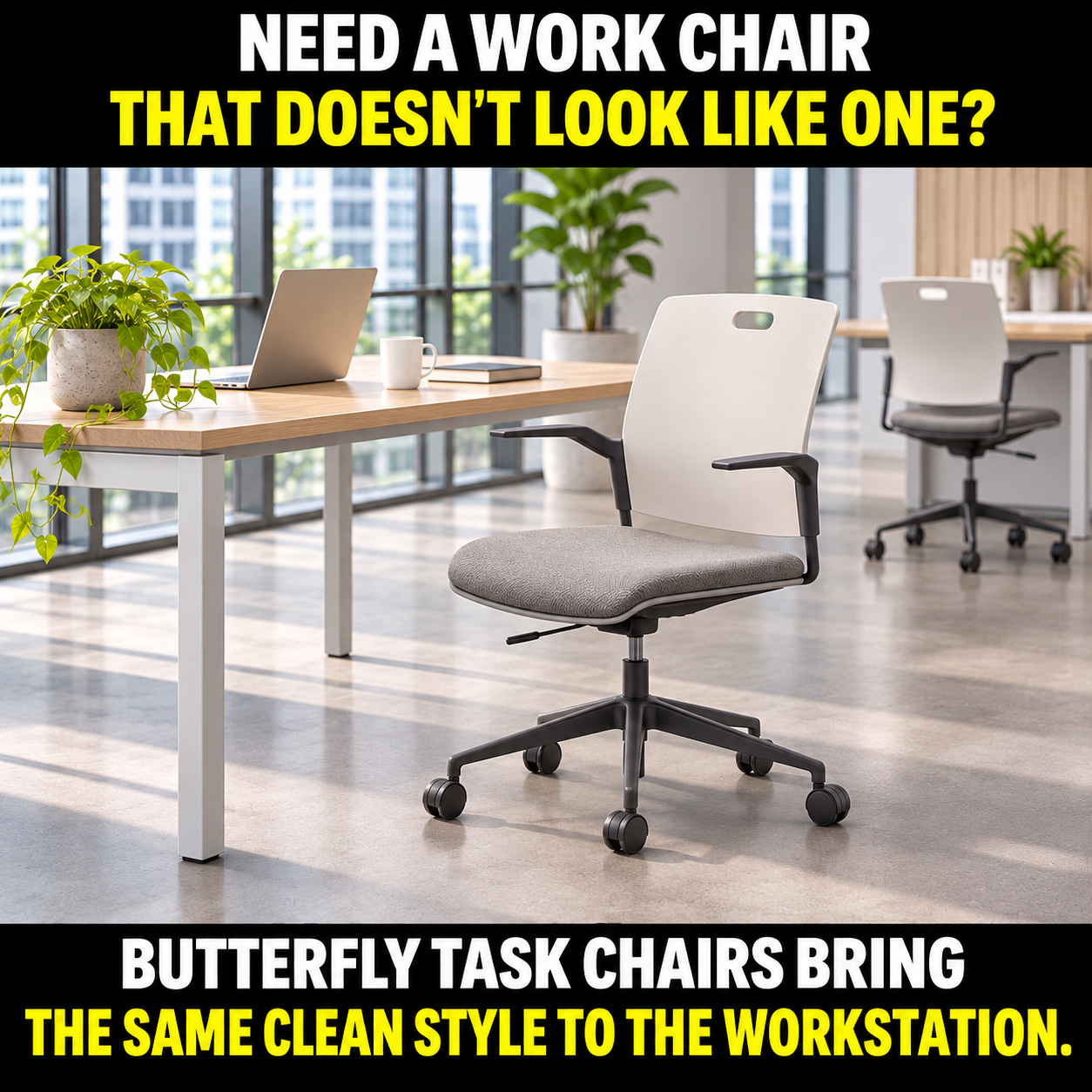
Butterfly also offers a task chair configuration.
When designers think about Butterfly, the first image that comes to mind may be a lightweight guest chair or a stack of meeting-room seating.
The task chair is a less obvious member of the collection.
But it provides an interesting option for projects that need rolling, height-adjustable seating without the visual complexity of a traditional ergonomic office chair.
The Butterfly 800 and 807 task chair models replace the conventional four-leg frame with a five-prong base on casters.
They also incorporate swivel functionality and seat-height adjustment.
This allows users to reposition themselves within a workstation and adjust the chair relative to the work surface.
The result is a chair that offers practical task-seating functions while maintaining the design language of the larger Butterfly family.
A different approach to workstation seating
Not every desk requires the same type of chair.
Some workstations are occupied throughout the day and demand extensive ergonomic adjustments.
Others are intended for shorter periods of use, shared activities, touchdown work, or flexible collaboration.
The appropriate seating choice depends on how the space is actually used.
Butterfly's task models may be worth evaluating for environments where mobility, simplicity, and a coordinated design are priorities.
Examples include:
Touchdown workstations
Shared office environments
Short-duration individual work areas
Collaborative project spaces
Administrative or support areas with suitable seating requirements
The task models have an adjustable seat-height range of approximately 16 to 21 inches, according to Nightingale's published specifications.
They are also available with or without arms and with selected upholstered-seat options.
Understand the intended application
An important distinction for specifiers is that Butterfly's task configuration should not automatically be treated as equivalent to a fully adjustable ergonomic task chair.
A chair intended for prolonged daily computer use may require additional features, such as more extensive seat, back, arm, or lumbar adjustments.
The Butterfly task chair offers a more straightforward set of functions.
That can be an advantage when the application calls for a simple, mobile seating solution.
But it also means the designer should evaluate the chair against the actual duration and type of work being performed.
The right task chair is not necessarily the one with the most adjustments. It is the one whose features match the intended use.
Butterfly gives project teams another option to consider.
One Office. Different Seating Needs. Why Mix Different Chair Styles?
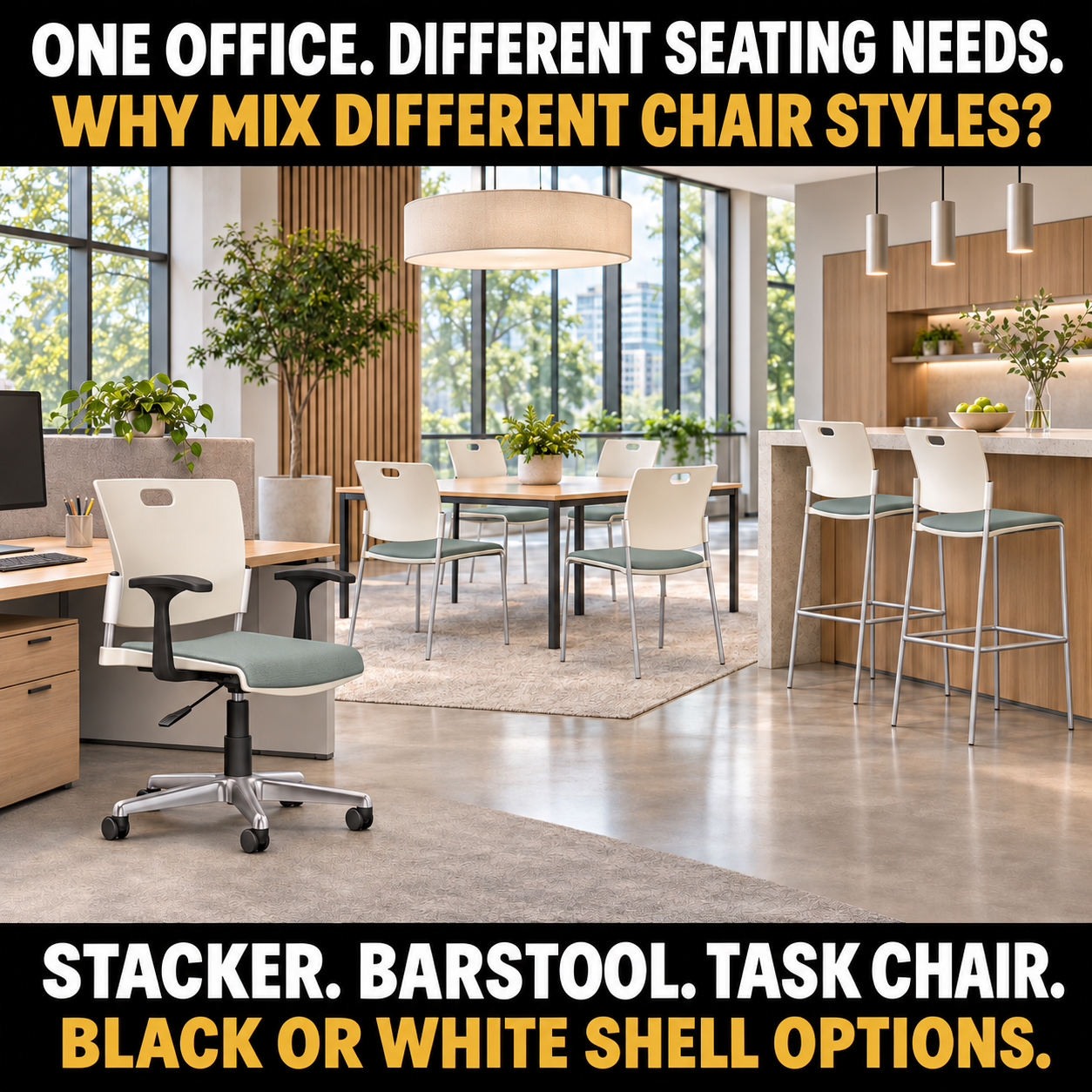
A coordinated seating family can bring visual consistency to an entire project.
An office may contain dozens of different seating locations.
Meeting rooms, café counters, individual workstations, shared collaboration tables, and reception areas all require different furniture configurations.
Often, these requirements are addressed independently.
One chair collection is selected for meeting rooms.
Another is used for café seating.
A third appears at individual workstations.
By the time the project is complete, the workplace may contain several unrelated chair styles.
There is nothing inherently wrong with that approach.
But when the design intent calls for a cohesive interior, using a coordinated seating family can simplify the visual language.
Butterfly offers that opportunity.
Three seating types. One recognizable design.
The collection includes:
Stacking chairs: Designed for meeting rooms, guest seating, and flexible spaces where furniture may need to be moved or stored.
Barstools: Intended for elevated seating applications, including compatible café counters, high tables, and informal gathering areas.
Task chairs: Featuring swivel functionality, casters, and seat-height adjustment for suitable workstation applications.
The individual models are different, but they share a recognizable seat and back profile.
That consistency can help connect spaces that otherwise have distinct functions.
For example, a workplace might specify Butterfly stacking chairs in its training room, barstools in the adjacent café, and task chairs at selected touchdown workstations.
The furniture supports three different activities while reinforcing one overall design direction.
Black or white: choosing the right finish
Butterfly's shell options provide another way to coordinate the collection with the interior.
A black shell can complement darker furniture, exposed architectural details, and contemporary commercial finishes.
A white shell can create a lighter appearance in bright offices, hospitality-inspired spaces, and interiors with natural wood or neutral palettes.
Frame finish and upholstery selections provide additional design opportunities.
For example, a designer might pair white shells with chrome-finished frames and muted upholstered seats to coordinate with a light oak furniture palette.
Alternatively, black shells and darker frames can establish a more restrained appearance.
The key is consistency.
Rather than treating each seating location as a separate design decision, the collection allows designers to establish a coordinated palette across different applications.
A consistent collection still needs individual specifications
Using one chair family does not mean every chair performs the same way.
Only the designated Butterfly stacking models should be specified for stacking.
Barstools have different seat heights and frame requirements.
Task chairs use swivel bases and casters rather than conventional four-leg construction.
Each configuration must be evaluated independently for dimensions, intended use, options, and performance.
This is particularly important when a project combines multiple models.
A consistent visual appearance should never replace technical coordination.
The strongest specifications balance design unity with functional differences.
That is where Butterfly's versatility becomes most useful.
What Matters Most
Butterfly provides an opportunity to simplify the visual language of a commercial interior while responding to several seating requirements.
But selecting the right model still begins with understanding the application.
Flexibility: The stacking models allow meeting and multipurpose rooms to be reconfigured as activities change.
Seating height: Barstool configurations accommodate elevated furniture, while standard guest and task chairs serve different work-surface heights.
Mobility: Task models offer swivel functionality, casters, and adjustable seat height.
Design consistency: Shared styling across the collection can help connect spaces with different functions.
Finish coordination: Black and white shell options, frame finishes, and upholstery selections allow seating to complement the larger interior palette.
Material considerations: Nightingale identifies recycled plastic construction in the molded seat and back, providing another product attribute for project teams to review when evaluating materials.
Before finalizing a specification, confirm the selected model, seat height, overall dimensions, arms, upholstery, frame finish, caster selection, stacking capability, and any project-specific requirements.
It is also important to verify current product availability and technical details against the manufacturer's latest documentation.
These considerations help ensure the seating is appropriate for both the people using it and the design surrounding it.
The Bottom Line
Different spaces need different seating. They don't always need different chair families.
Nightingale's Butterfly collection offers a practical way to approach seating across a variety of commercial environments.
Stackable guest chairs support rooms that need to change.
Barstools extend the same aesthetic to elevated counters and gathering spaces.
Task chairs introduce mobility and height adjustment for suitable workstation applications.
And across these configurations, the collection's recognizable design and finish options allow architects and interior designers to create a more coordinated environment.
The value is not simply that Butterfly comes in several versions.
It is that those versions can serve different purposes while contributing to one larger design concept.
Because when a workplace changes throughout the day, the furniture should be selected with that flexibility in mind.
One chair family. More ways to use a space.
Let's Talk About Your Next Seating Project
Planning a new office, multipurpose meeting space, café, or commercial interior?
The Ginger Grant Group can help you explore Nightingale's Butterfly collection, compare available configurations, and identify seating options that support your project's functional and design goals.